


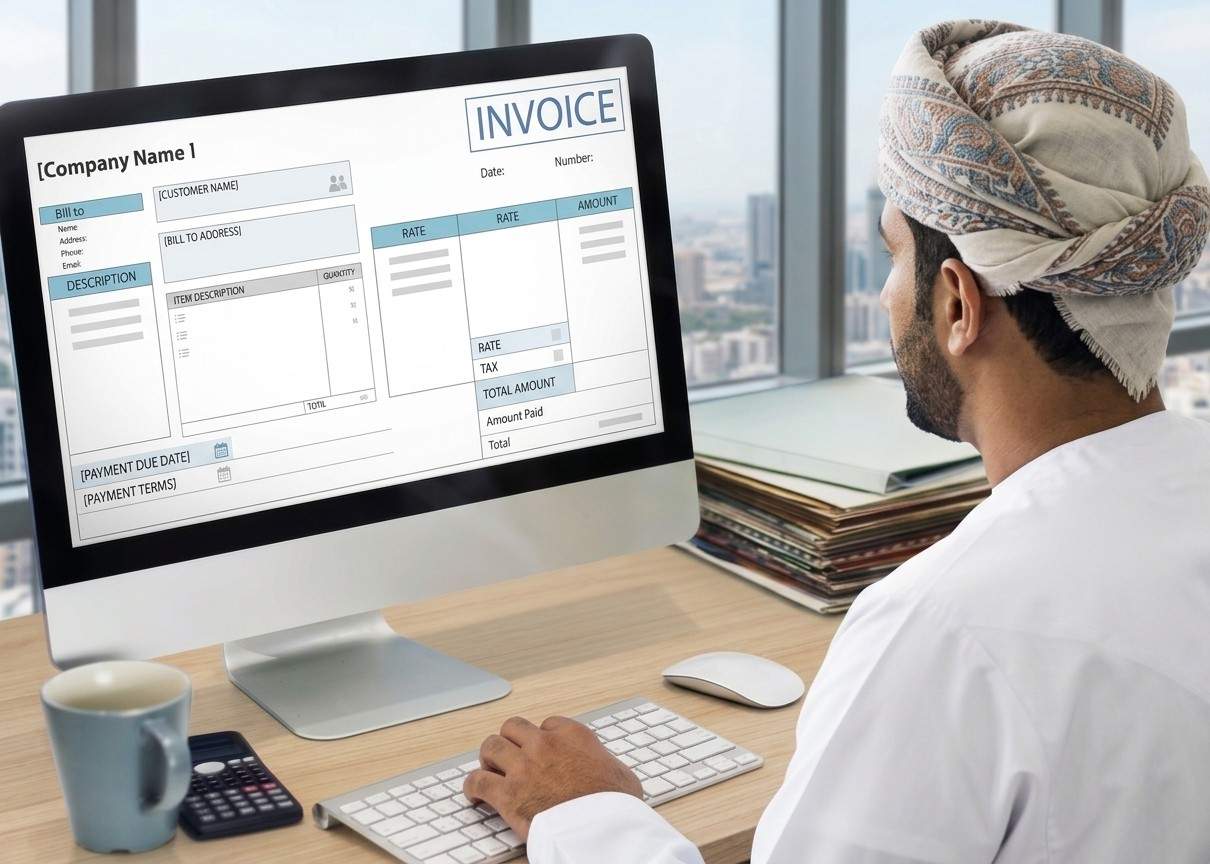
Fawtara is Arabic for invoice straightforward, because that is exactly what this system governs. Every invoice a VAT-registered business issues in Oman now falls within its scope. The Oman Fawtara E-Invoicing framework has been years in the making; it is live, the deadlines are moving, and businesses still treating this as a future concern are already running late. Understanding what Oman Fawtara E-Invoicing requires and what it does not is the first step toward getting ready.
Overview of the Oman Fawtara E-Invoicing System
Invoices under Fawtara must come out of OTA-certified software producing structured, machine-readable data not PDFs, not Word files, not anything typed and emailed manually. Each one carries a cryptographic digital signature and a QR code before flowing to the Oman Tax Authority e-invoicing platform for submission or clearance, either just ahead of or immediately after the buyer receives it.
Whether your business falls under the clearance or reporting model depends on size and transaction type under Oman Fawtara E-Invoicing. What stays constant is this: the Authority must be able to see, read, and verify every invoice. A scanned PDF does not clear that bar. Sending something digitally is not the same as sending structured data and that is precisely the gap that catches businesses off guard when they first look closely at what Oman e-invoice compliance actually demands.
Oman is following the same path Saudi Arabia and the UAE have already taken: close tax gaps, reduce evasion, bring invoice data under direct oversight. Businesses that followed those earlier rollouts will have a clear sense of where this leads.
Oman Tax Authority Fawtara Compliance Requirements
The OTA has left little room for interpretation here. Once a mandatory deadline applies, there is no self-paced phasing, no partial compliance window. The obligations are fixed from day one.
- Mandatory Data Fields: Seller tax registration number, buyer TRN on all B2B and B2G transactions, a unique sequential invoice number, exact date and time of issuance, an itemised breakdown of goods or services, VAT amounts, total payable, a digital signature, and a QR code. Every field, every invoice. One missing element and the invoice fails full stop.
- Recognised Invoice Types: Standard tax invoices for B2B and B2G transactions, simplified invoices for qualifying B2C sales below the relevant threshold, credit and debit notes for corrections, and self-billing invoices. Each carries its own data requirements. A business handling multiple types of needs its system set up for all of them not just the most frequent one.
- Registration: Software must be formally registered with the OTA and pass technical certification before the first Fawtara-compliant invoice goes out, with the system linked to the OTA portal. Businesses relying on third-party providers need written confirmation of that vendor’s current certification status verbal assurance is not enough.
- Archiving: Oman e-invoice compliance extends well beyond issuance. Every invoice must be held in tamper-proof storage for a minimum of ten years, original digital signatures preserved, and made available for OTA inspection on request.
Fawtara E-Invoicing Implementation Timeline in Oman
The rollout is structured by business size under Oman Fawtara E-Invoicing. Large enterprises those crossing the OTA’s turnover thresholds face the earliest mandatory dates under Oman e-invoicing 2026. Smaller businesses follow in subsequent phases, with the OTA publishing specific dates and thresholds ahead of each wave.
Voluntary adoption is open right now. Going early gives businesses time to find and fix problems before any deadline makes them expensive that is the only real advantage on offer, but it is a significant one. Those that wait tend to find too little time, too few available vendors, and no room to test properly.
Saudi Arabia’s Fawtara e-invoicing Oman equivalent its Phase 2 rollout is instructive here. A substantial share of mid-sized businesses arrived underprepared despite a full prior phase to learn from. Oman businesses have that same forewarning now. Whether they act on it is another matter.
Technical Requirements for Fawtara E-Invoicing Integration
This is where most businesses discover how far they actually are from being ready. The requirements are not complicated to understand but they are not trivial to implement either.
- Structured XML Format: The OTA accepts invoices in structured XML only. PDF, Excel, and Word are not alternatives. If existing systems cannot produce compliant XML output, they need to be upgraded or replaced. No other route exists.
- API Connectivity: Real-time clearance means a live API connection between the business’s invoicing system and the OTA platform under Oman Fawtara E-Invoicing. This is genuine software development work. The OTA provides documentation and a sandbox environment, but proper integration takes weeks not afternoons.
- Digital Certificates: Every invoice requires a cryptographic signature via an OTA-issued certificate obtained during onboarding. It must be in place before live invoicing begins this cannot be added retrospectively.
- QR Codes: An OTA-specification QR code is mandatory on every invoice, printed or digital, and must be machine-readable on every external copy.
- ERP Readiness: Oman e-invoice implementation depends heavily on what your existing ERP or accounting platform can actually do. Some vendors already offer certified Fawtara modules; others need significant reworking or replacement. Determining which situation you are in early is what sets a manageable project apart from a rushed one.
Benefits of Fawtara E-Invoicing for Oman Businesses
Regulatory obligation is what drives Oman Fawtara E-Invoicing adoption, but the operational upside is real. Finance teams that have come through the transition tend to find it more worthwhile than expected, especially with solutions like Malaysia Advintek supporting smooth implementation.
- Faster Payments: Structured invoices cut the manual re-entry that delays buyer-side approval under Oman Fawtara E-Invoicing. In sectors where payment cycles have historically been slow government contracting, construction, professional services the difference can be substantial.
- Lower Processing Costs: Printing, postage, chasing, manual reconciliation individually easy to overlook, considerable in aggregate. High-volume businesses typically find compliant technology pays for itself within a year.
- Cleaner Audit Trail: Digital signatures, timestamps, and full traceability on every invoice mean tax audits become far less disruptive. Records are complete and searchable in seconds, not scattered across filing cabinets.
- Commercial Credibility: Government bodies and larger private-sector organizations scrutinize supplier compliance more closely than they used to under Oman Fawtara E-Invoicing. Fawtara certification is increasingly a baseline expectation a commercial signal, not just a regulatory tick.
- Real-Time Visibility: Invoice data flows straight into reporting without manual processing lag. Live receivables, accurate VAT positions, faster month-end closes the finance function runs more smoothly.
How Businesses Can Prepare for Oman Fawtara E-Invoicing
There is no credible last-minute path here under Oman Fawtara E-Invoicing. Businesses that come through without major disruption are those that started early, assigned real ownership, and worked through the process properly.
- Audit Your Current Invoicing Process: Map how invoices are created today, what data they carry, how they reach customers, how they are stored. This baseline is the foundation for every decision that follows skipping it means building on guesswork.
- Select OTA-Certified Software: Certification comes before cost and features. A certified vendor charging more will almost always be the right call over a cheaper uncertified option when the compliance deadline is firm and non-negotiable.
- Align Finance and IT Early: Most troubled implementations come down to finance and IT operating separately under Oman Fawtara E-Invoicing. One project lead should own both sides, milestones need clear accountability, and leadership sign-off on scope and budget should happen before work starts.
- Complete OTA Onboarding and Testing: Formal registration, digital certificate issuance, and full sandbox testing all of it before go-live. Test every invoice type in use. Problems found in the sandbox are solvable. Problems after go-live are costly and may attract penalties.
- Train the Right People: Invoice issuers, rejection handlers, VAT reporting staff each group needs training built around their specific role under Oman Fawtara E-Invoicing. One combined session rarely holds. Compliance breaks at the human layer more often than the technical one.
- Monitor After Go-Live: Error log reviews, fast handling of rejected invoices, and tracking OTA updates are ongoing responsibilities. Go-live is not the finish line.
Conclusion
The Fawtara e-invoicing Oman rollout marks a permanent change Oman Fawtara E-Invoicing is not a transitional measure that eases once the initial wave passes. The OTA has been consistent on direction and timeline, and that consistency should be taken at face value.
Businesses that hold off will arrive at the Oman e-invoicing 2026 deadlines with fewer vendor choices, compressed timelines, and higher costs under Oman Fawtara E-Invoicing. The compliance obligation is reason enough to act but better data, faster payments, and cleaner records make the case stronger still. The right time to begin was months ago. The practical time is now.
FAQs
Q1. What is Oman Fawtara e-invoicing?
The OTA’s mandatory electronic invoicing framework covering all VAT-registered businesses in Oman.
Q2. Which businesses must comply?
Every VAT-registered entity operating in Oman, phased in by size and turnover.
Q3. When does the Oman e-invoicing 2026 mandate take effect?
Large enterprises face the earliest deadlines; SMEs follow in subsequent phases.
Q4. What invoice format does the OTA require?
Structured XML with a valid digital signature and an OTA-compliant QR code.
Q5. Can I keep using my existing accounting software?
Only if the vendor holds current OTA certification confirm this in writing.
Q6. What penalties apply for non-compliance?
Financial penalties and potential operational restrictions enforced by the OTA.
Q7. Does Fawtara cover B2C invoices?
Yes, qualifying B2C transactions fall under simplified invoices within the framework.
Q8. How long must invoices be archived?
Ten years minimum, tamper-proof storage, original signatures intact, available for OTA inspection.
Q9. Are foreign businesses in Oman subject to Fawtara?
Yes, VAT registration in Oman carries the same obligations regardless of where the business is based.
Q10. Where should implementation begin?
The OTA portal is the official starting point under Oman Fawtara E-Invoicing; certified local technology providers are the recommended route for practical support.
Source by:
Image by Gemini