


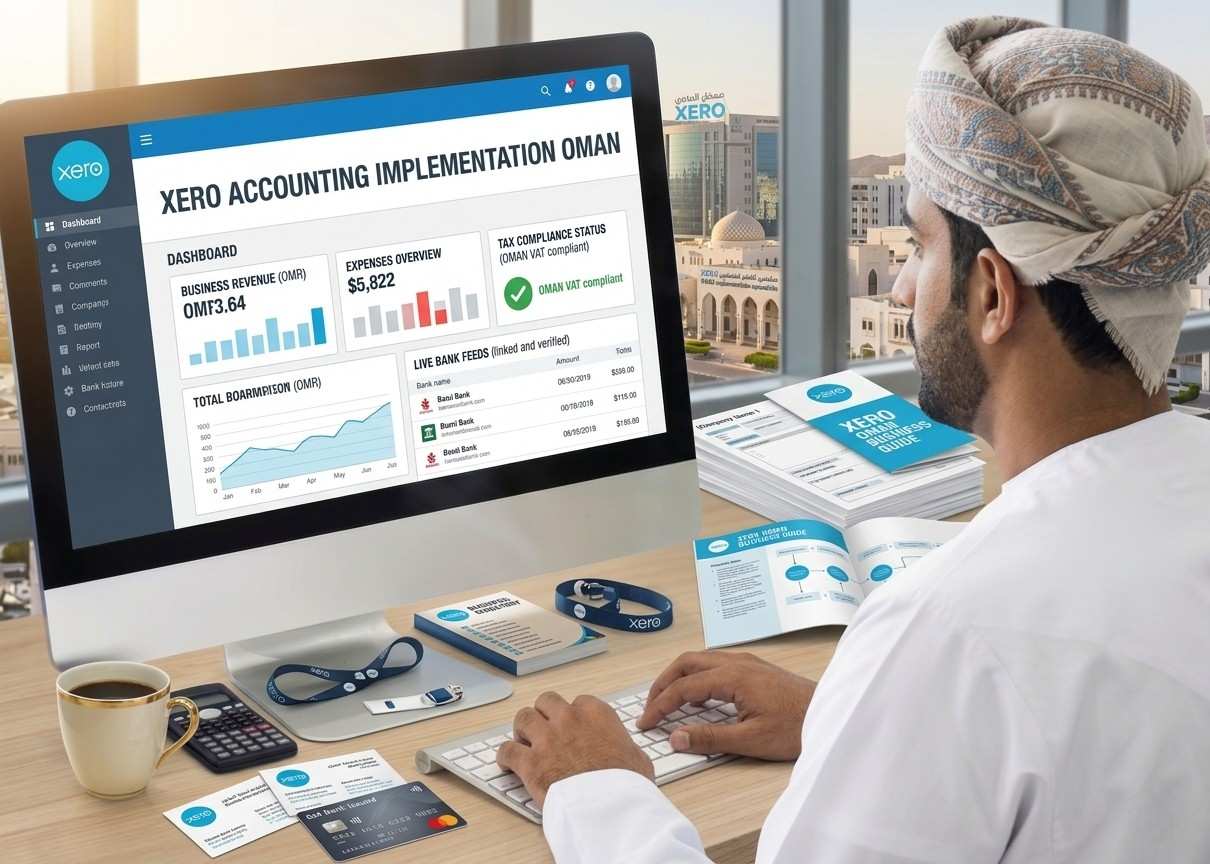
Overview of Xero Accounting for Oman Businesses
Finance teams in Oman deal with VAT returns, WPS payroll deadlines, audit obligations, and management demanding current data not summaries from three weeks ago. Most businesses hit a point where their existing system simply cannot keep pace. That is where Xero Accounting Implementation Oman enters the picture.
Xero was built from the ground up as a cloud platform. Real-time data, connected bank feeds, live reporting these are structural features, not surface-level additions. Businesses using it daily describe the experience very differently from those who have only seen a demonstration.
Xero accounting services Oman have grown because the platform handles Oman’s VAT framework, WPS payroll obligations, and multi-currency transactions as part of a standard implementation not as workarounds. Firms across the country have adopted it for that straightforward reason.
This piece covers Xero Accounting Implementation Oman practically what works, how implementation runs, and what separates a reliable partner from a poor one.
Key Features of Xero Accounting Implementation
What makes Xero Accounting Implementation Oman worth pursuing is that its strongest features are also the most used ones not capabilities reserved for edge cases.
- Real-Time Financial Dashboard: Live balances, open invoices, bill obligations, and cash position are visible to any authorised user at any time. Management does not wait for a compiled report to understand where the business stands.
- Automated Bank Reconciliation: A live bank feed matches transactions against records automatically. What previously took hours now takes minutes, and the error rate drops sharply.
- Multi-Currency Transactions: Foreign currency transactions convert automatically at live rates. Both sides of the entry stay in sync with no manual adjustment needed.
- VAT Management: Tax codes and return formats align with Oman’s VAT framework from day one. Return preparation becomes a routine export, not a reconstruction exercise.
- Invoicing and Payment Tracking: Invoices go out from Xero, status updates automatically, and overdue reminders run without manual intervention.
- Payroll Integration: WPS-compliant payroll tools post salary costs to Xero automatically each pay cycle, eliminating double entry and reconciliation gaps.
- Fixed Asset Register: Depreciation schedules and asset values sit in Xero, reducing year-end and audit preparation time considerably.
- Role-Based User Access: Each user accesses only what their role requires. Internal controls and data security are structural, not an afterthought.
Benefits of Xero for Growing Businesses in Oman
Growth complicates finances faster than most owners anticipate. More clients, more suppliers, more reporting lines and the finance function quickly becomes a constraint. Xero bookkeeping Oman removes that constraint before it starts limiting the business.
The time recovery shows up within weeks, especially with a well-executed Xero Accounting Implementation Oman. Reconciliation that used to stretch across days is handled in one sitting, and invoice management, previously spread across email threads, consolidates into a single view. That time gets redirected into the business.
Financial visibility shifts materially. Decisions that previously waited on a summary prepared by an accountant days later now get made with current data, by the person who needs to make them, without an intermediary in the way.
Audit preparation changes. Records are complete, timestamped, and traceable. There is no scramble to locate documents or explain gaps everything the auditor needs is already there.
For businesses approaching banks or investors, accounts maintained in a recognised platform carry real weight. Lenders notice its absence as much as its presence.
Xero cloud accounting Oman means finance infrastructure is not tied to one office or one machine. The system works from wherever the business operates valuable for multi-site companies and travelling owners alike.
Xero accounting services Oman cost less than most businesses expect when reconciliation time, error correction, and IT overhead are all factored in. The full economics of Xero Accounting Implementation Oman look quite different from the subscription line item alone.
Xero Integration with Business and ERP Systems
A reasonable concern before any Xero Accounting Implementation Oman is whether it connects to what the business already uses. In most cases, it does and often better than expected, especially when supported by experienced providers like Singapore Advintek.
Organisations running SAP, Microsoft Dynamics, or Oracle NetSuite bring in Xero as the accounting layer. Data from the ERP flows across without duplication, without manual re-entry, and without creating parallel records that need reconciling.
Retail businesses connect their POS so that every sale records directly into Xero at the point of transaction. By close of business, the accounts already reflect the day’s revenue—nothing to batch, nothing to transfer.
E-commerce platforms like Shopify pull through orders, refunds, and settlements automatically, so accounts stay current without manual upkeep.
WPS payroll tools post journals each pay cycle automatically. Expense apps like Dext convert photographed receipts into coded Xero entries, removing manual expense processing entirely.
These connections to CRM platforms, inventory systems, and project tools turn the platform into a connected financial layer across the business, especially when supported by a well-planned Xero Accounting Implementation Oman. The value depends entirely on how well they are planned and tested before going live.
Integration treated as an afterthought creates problems post-launch. A good partner plans connections from the start, configures each one properly, and tests data flows in both directions before go-live.
Steps for Xero Accounting Implementation in Oman
Businesses that have a poor experience with Xero Accounting Implementation Oman almost always trace the problem back to how setup was handled. A clean Xero setup Oman is methodical, and each stage depends on the one before it being done properly.
- Business Review: Legal structure, transaction flows, existing tools, compliance obligations, and reporting requirements are understood properly before configuration begins. This shapes every decision that follows.
- Chart of Accounts Design: Built specifically for the business, not lifted from a template. Cost centres, revenue lines, and categories must reflect how the business is actually managed.
- Data Migration: Opening balances, records, and historical data migrate with full integrity verification. Errors here create reconciliation problems for months this is not a stage to rush or cut corners on.
- Tax and Compliance Setup: VAT rates, return templates, and applicable withholding or customs requirements are configured once to Oman’s framework. Compliance reporting runs automatically from there.
- System Integrations: Every connection like payroll, POS, CRM, inventory management is configured and tested thoroughly. Data flows are verified in both directions. Nothing goes live with an untested link.
- User Training: Delivered by role. Finance staff on reconciliation and reporting, operations on invoicing and purchasing, management on dashboards and the reports they actually use.
- Go-Live and Ongoing Support: The first weeks in live operation are monitored actively. Issues that appear in a real environment are resolved without delay, and dedicated support continues beyond launch for regulatory changes, system adjustments, and retraining needs.
Choosing the Right Xero Implementation Partner in Oman
Most of the risk in a Xero project does not sit with the software. It sits with the partner. Choosing well matters more than most businesses assume going in.
Platform certification is the starting point, not the destination. What matters in Oman is whether the firm genuinely understands the VAT framework, what the OTA requires, and how WPS payroll must be reflected in the accounts—something critical for a successful Xero Accounting Implementation Oman. A partner working these out during your project is a problem, not a learning opportunity.
Sector experience shapes implementation quality more than most clients expect. A firm that has configured Xero for construction, trading, or professional services businesses in Oman will make better decisions, faster—something especially valuable in a Xero Accounting Implementation Oman. Ask specifically what they have delivered in your industry.
Post-implementation Xero accounting support Oman is not optional. Regulations shift, businesses grow, staff turns over. The relationship must be structured for continuity, not just for go-live.
Providers worth working with have references from comparable businesses. Speak to them. The experience after go-live tells you more than anything during the sales process.
Discuss data migration explicitly. Ask how opening balances are handled, how post-migration accuracy is verified, and how discrepancies get resolved. Firms without clear answers to these questions represent a real risk.
Conclusion
Xero Accounting Implementation Oman is ultimately about giving the business a financial foundation that actually serves it one that keeps records clean, supports compliance, and gives management the visibility they need to make decisions without delay.
Businesses in Oman running Xero properly are not just faster at admin they make decisions from a fundamentally clearer financial picture, and that difference compounds over time.
The difference between a well-implemented setup and a poorly executed one is almost always the partner, especially in a Xero Accounting Implementation Oman project. Choose carefully, plan properly, and the return on the investment is not difficult to see.
Frequently Asked Questions (FAQs)
Q1. What is Xero Accounting Implementation Oman?
Deploying and configuring Xero’s cloud platform for financial management in Oman-based businesses.
Q2. How long does Xero implementation in Oman typically take?
Two to eight weeks, depending on the size and complexity of the business.
Q3. Does Xero support Oman VAT compliance?
Yes. Tax codes and return templates are configured specifically to Oman’s VAT framework.
Q4. What do Xero accounting services Oman typically cover?
Implementation, bookkeeping, reporting, system integrations, and ongoing compliance support.
Q5. Can Xero work alongside existing ERP platforms?
Yes. It integrates with SAP, Microsoft Dynamics, Oracle NetSuite, and similar systems.
Q6. What does Xero bookkeeping Oman involve in practice?
Daily transaction entry, bank reconciliation, invoicing, payroll journals, and financial reporting.
Q7. Is Xero cloud accounting Oman suitable for smaller businesses?
Yes. The platform is designed to scale from small operations through to large enterprises.
Q8. What does Xero accounting support Oman include after go-live?
Compliance updates, system adjustments, troubleshooting, and user retraining as required.
Q9. Does Xero handle multi-currency accounting?
Yes. It manages foreign currency transactions with automatic conversion at live exchange rates.
Q10. What matters most when selecting a Xero partner in Oman?
Local regulatory knowledge, sector experience, Xero certification, and a commitment to post-launch support.
Source by:
Image by Gemini